

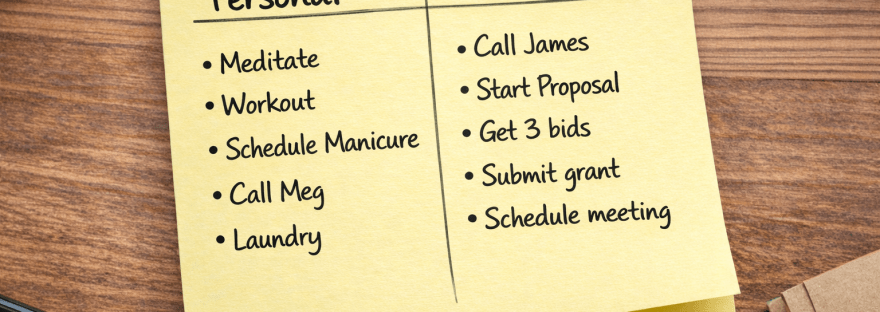
The Left Side of the Sticky Note: Prioritize Yourself

I’m sure you’re wondering what the heck I mean by the title of this one. Give me a moment to explain.

I’m a list maker, a to-do list lover, and boy, do I enjoy crossing things off of said list. It makes me feel like I’m accomplishing something. (There’s probably some perfectionism, overachiever tendencies to unpack there, but bear with me, that’s for another day). And for as long as I can remember, Monday-Friday, I make daily to-do lists on a sticky note. It helps keep me on track, I think.

I have columns on my sticky note: The left side, usually the higher-priority side, is for work items. The right side is personal to-dos, such as making appointments, phone calls, emails, cleaning, running errands, and such. I even include workouts, meditation, drinking water, and other healthy behaviors that benefit from reminders.

But here’s the thing. Also, for as long as I can remember, the left side gets done first. It’s almost always been work above self. The left side gets checked off, I feel like I’m “good at work”, but the right side falls behind. I get left behind. Everything and everyone else first. Almost every single day. This is not intended to be a pity-party, it’s intended to be a honest reflection about the way I’ve lived my life and the choices I’ve made. Clearly, I’ve made some mistakes (who hasn’t?). As I’ve alluded to in previous posts, I think balance is nearly impossible, but we can try to an extent.

So I’m making an adjustment, and I hope you will too, in whatever similar way might resonate with you, be it a sticky note or just a re-prioritization of yourself. As small and simple as it seems, I’m now putting the non-work, personal to-dos on the left. AND probably more importantly, giving myself permission to complete those things first, or at least as a priority, where possible.

I’ve been working on this for a few days now and have had some key observations:

  1. It takes a conscious effort to break old patterns and habits.
  2. It takes micro-adjustments over time to achieve change and success. Lean into this and celebrate even the smallest win.
  3. And permission. Don’t forget to give yourself permission.
  4. One huge factor, I’m learning, is removing a false sense of urgency and immediacy that accompanies our current work culture in the good ol’ U.S. of A.
    • Here’s an example: This morning, after a work meeting, I meditated and journaled over the course of about 45 minutes at (gasp!) 10am, when the rest of the world is working and moving along at a rapid pace. (Mind you, I am a contractor, and I can complete my work on my own time- and yes, I feel the need to justify this… but I’m working on it). I put my phone on Do Not Disturb. For 45 minutes. When I turned off Do Not Disturb, I opened my phone to 2 new work voicemails, 16 parent group chat notifications, 18 family group chat notifications, 7 emails, and 1 text. In 45 minutes. It’s no wonder so many of us live in a constant state of over-stimulation and anxiety. Most of these items needed my attention at some point, and my first conditioned reaction was to be filled with anxiety and urgency. I should address all of those things immediately and skip the workout that I had planned next. That’s what people expect after all. Or do they? Here’s the work: Pause and reflect on the true urgency of all of those things. None were urgent. So… I prioritized. I completed the workout, took a shower, and addressed, in order, what I needed to do first, redirected some of it, and read but did not respond to the group chats (who invented that anyway??), and at the end of the day, I got everything done that I wanted to. INCLUDING, and importantly, taking care of myself.
  5. As above… Its about prioritization. And, my friend, you should be a priority. Period.

Look, I get it. Some days, weeks, and even months feel like the to-do lists are endless, work just won’t let up, and prioritizing yourself in any way isn’t possible. But I ask you, I beg you, my friend, to consider completing what really matters first, and that includes you.

And here’s a secret bit of magic: If you make yourself a priority, you’ll likely feel better, be more present, and show up in a more positive way for others. Kindness, patience, and heck, efficiency at work might just be an unintended benefit that you’ll love. There is a high chance (I’ve experienced it already) you’ll WANT to do more for others. It’s a win/win.

So, if it resonates in some way, re-order your to-do list, put yourself first when you can, pause, and consider the true urgency of any situation or task. I can guarantee it’ll be eye-opening, and my hope is that it will positively affect you in a significant way.

Cheers,

Sarah

Navigating Disappointment and Heartbreak

All too often, life throws us curveballs.

Letdowns, disappointment, hurt feelings, failed expectations, breakups, “no’s”, and missed opportunities are part of life but can be incredibly challenging to navigate in the moment. It can literally and figuratively feel like nothing goes right, and the gloomy, lonely “winter” will continue forever. (Did I mention it’s winter right now?). It can make you feel worthless, unappreciated, or like what you once thought was true was all a lie. It can get pretty dark or negative pretty fast if you let it.

These feelings and experiences have been in my personal and professional orbit lately, so I thought I’d explore what works and what doesn’t when facing them. For me, at least.

While I’m not talking about true grief and loss here, it is, in a way, reflective of the grief cycle: Disappointment, Anger, Bargaining, Depression, and Acceptance. Of course, this is not a linear process, but it can be helpful to consider where you fall in the process at any given moment. And guess what. It’s OK, and NORMAL to experience all of these feelings, and even oscillate between them. Give yourself permission, please.

Too often, we’re expected to “put some lipstick on it”, “put your big girl panties on,” and “get over it” without having the opportunity to feel sad, reflect, or consider how a disappointment might, in the long run, lead to an even better path. Disappointment and heartbreak will lessen with time, I promise.

So here’s my take on what works, and what doesn’t. No research this time – except a lifetime of reading, journaling, meditating, and podcast listening:). Oh, and some recent practice.

What to do, in no particular order:

  • Feel the feelings. If we bottle it up, the issues live in the tissues.
  • Talk to a trusted friend or family member. Let it out. It’s ok! Cry if you need to. I mean, don’t resort to violence, but if you need to scream into, or punch a pillow, go for it.
  • Breathe, slow down. Really. When all else fails, tap into your breathing, slow your heart rate.
  • Consider what works for you, or what’s worked in the past. Exercise? Meditation? Journaling? Time with friends? Fresh air? Do that.
  • Give yourself time. Emotions don’t need to be processed in a day.
  • Give yourself grace. Please!
  • When you feel ready, take time to reflect. Some of these questions might be helpful:
    • Is there a side of this story I haven’t considered?
    • Are there areas that I have no control over? If so… let it go.
    • What can I control? Usually, that’s something like my reaction or next steps.
    • This one can be tough, but… Is it possible that this disappointment or this outcome may actually lead me in a better direction? Often, the answer is yes.
  • Was it a really big disappointment, or even a “failure”? Do an after-action report. Its quite similar to reflection, but more formalized. I know it sounds a little much, like “isn’t that for big workplace events or something”? I’ve done it personally, and it can be extremely helpful for identifying what went well, opportunities for improvement, and trends. Some questions to consider:
    • What did I do well in this situation?
    • What would I do again?
    • What can I learn that might be useful in the future?
    • What do I have control over?
    • What went poorly?
    • How can I learn and grow from this experience? This can be huge!
    • What do I NOT have control over, and how can I use that to move on?
    • Do I see any patterns, for good or for bad here? How can they inform my future actions?
    • Write it all down, look back at it, and it can be quite illuminating.
  • Very importantly, when you’re ready, let go, move on. Please.

What not to do, in no particular order:

  • Blame yourself for the outcome. I firmly believe that people do the best they can with what they have at any given time. Be proud of yourself, recognize and own that.
  • Blame others for the outcome. Really. I mean, you can, for a second, be mad, but then let that shit go. Is it making you feel better? If holding that anger and grudge makes you feel worse (it probably does), then let it go.
  • Shame yourself for feeling disappointed or sad. Remember, feel the feelings! It’s ok!
  • Feel embarrassed or less than. Hold your head high. Please, you beautiful human!
  • Hurry or sweep those feelings under the rug. You do you on your own time.
  • Lash out or react without a pause and consideration. Is your reaction to this situation how you want to act? If not, give it a minute, breathe, and send that text or email later. It can and should wait. There is magic in the pause.
  • Catastrophize. It can be easy to go down a worst-case-scenario rabbit hole. Don’t. Bring yourself back to reality. Phone a friend to help with that if you need.
  • Make reactive decisions. This is a big one. Breathe, pause, wait, consider. Make calm and informed decisions. Later. Whatever “later” is for you.

In summary, when you’re in the midst of “winter”, allow yourself to feel, lean into what works for you, take a pause and a breath, and know that spring is right around the corner.

Love to you all as you navigate life’s ups and downs.

-Sarah