The Left Side of the Sticky Note: Prioritize Yourself

I’m sure you’re wondering what the heck I mean by the title of this one. Give me a moment to explain.

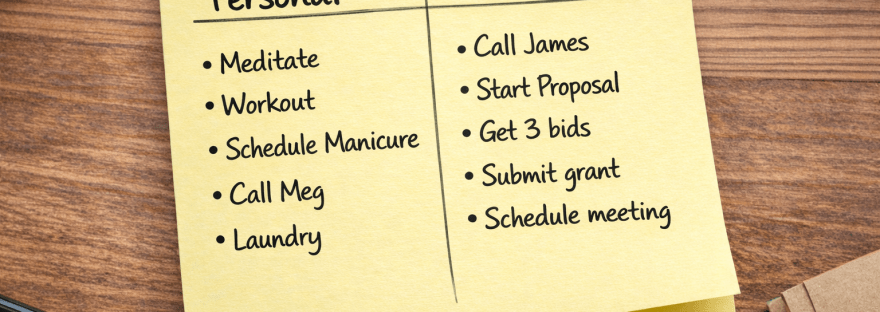
I’m a list maker, a to-do list lover, and boy, do I enjoy crossing things off of said list. It makes me feel like I’m accomplishing something. (There’s probably some perfectionism, overachiever tendencies to unpack there, but bear with me, that’s for another day). And for as long as I can remember, Monday-Friday, I make daily to-do lists on a sticky note. It helps keep me on track, I think.

I have columns on my sticky note: The left side, usually the higher-priority side, is for work items. The right side is personal to-dos, such as making appointments, phone calls, emails, cleaning, running errands, and such. I even include workouts, meditation, drinking water, and other healthy behaviors that benefit from reminders.

But here’s the thing. Also, for as long as I can remember, the left side gets done first. It’s almost always been work above self. The left side gets checked off, I feel like I’m “good at work”, but the right side falls behind. I get left behind. Everything and everyone else first. Almost every single day. This is not intended to be a pity-party, it’s intended to be a honest reflection about the way I’ve lived my life and the choices I’ve made. Clearly, I’ve made some mistakes (who hasn’t?). As I’ve alluded to in previous posts, I think balance is nearly impossible, but we can try to an extent.

So I’m making an adjustment, and I hope you will too, in whatever similar way might resonate with you, be it a sticky note or just a re-prioritization of yourself. As small and simple as it seems, I’m now putting the non-work, personal to-dos on the left. AND probably more importantly, giving myself permission to complete those things first, or at least as a priority, where possible.

I’ve been working on this for a few days now and have had some key observations:

  1. It takes a conscious effort to break old patterns and habits.
  2. It takes micro-adjustments over time to achieve change and success. Lean into this and celebrate even the smallest win.
  3. And permission. Don’t forget to give yourself permission.
  4. One huge factor, I’m learning, is removing a false sense of urgency and immediacy that accompanies our current work culture in the good ol’ U.S. of A.
    • Here’s an example: This morning, after a work meeting, I meditated and journaled over the course of about 45 minutes at (gasp!) 10am, when the rest of the world is working and moving along at a rapid pace. (Mind you, I am a contractor, and I can complete my work on my own time- and yes, I feel the need to justify this… but I’m working on it). I put my phone on Do Not Disturb. For 45 minutes. When I turned off Do Not Disturb, I opened my phone to 2 new work voicemails, 16 parent group chat notifications, 18 family group chat notifications, 7 emails, and 1 text. In 45 minutes. It’s no wonder so many of us live in a constant state of over-stimulation and anxiety. Most of these items needed my attention at some point, and my first conditioned reaction was to be filled with anxiety and urgency. I should address all of those things immediately and skip the workout that I had planned next. That’s what people expect after all. Or do they? Here’s the work: Pause and reflect on the true urgency of all of those things. None were urgent. So… I prioritized. I completed the workout, took a shower, and addressed, in order, what I needed to do first, redirected some of it, and read but did not respond to the group chats (who invented that anyway??), and at the end of the day, I got everything done that I wanted to. INCLUDING, and importantly, taking care of myself.
  5. As above… Its about prioritization. And, my friend, you should be a priority. Period.

Look, I get it. Some days, weeks, and even months feel like the to-do lists are endless, work just won’t let up, and prioritizing yourself in any way isn’t possible. But I ask you, I beg you, my friend, to consider completing what really matters first, and that includes you.

And here’s a secret bit of magic: If you make yourself a priority, you’ll likely feel better, be more present, and show up in a more positive way for others. Kindness, patience, and heck, efficiency at work might just be an unintended benefit that you’ll love. There is a high chance (I’ve experienced it already) you’ll WANT to do more for others. It’s a win/win.

So, if it resonates in some way, re-order your to-do list, put yourself first when you can, pause, and consider the true urgency of any situation or task. I can guarantee it’ll be eye-opening, and my hope is that it will positively affect you in a significant way.

Cheers,

Sarah

Navigating Disappointment and Heartbreak

All too often, life throws us curveballs.

Letdowns, disappointment, hurt feelings, failed expectations, breakups, “no’s”, and missed opportunities are part of life but can be incredibly challenging to navigate in the moment. It can literally and figuratively feel like nothing goes right, and the gloomy, lonely “winter” will continue forever. (Did I mention it’s winter right now?). It can make you feel worthless, unappreciated, or like what you once thought was true was all a lie. It can get pretty dark or negative pretty fast if you let it.

These feelings and experiences have been in my personal and professional orbit lately, so I thought I’d explore what works and what doesn’t when facing them. For me, at least.

While I’m not talking about true grief and loss here, it is, in a way, reflective of the grief cycle: Disappointment, Anger, Bargaining, Depression, and Acceptance. Of course, this is not a linear process, but it can be helpful to consider where you fall in the process at any given moment. And guess what. It’s OK, and NORMAL to experience all of these feelings, and even oscillate between them. Give yourself permission, please.

Too often, we’re expected to “put some lipstick on it”, “put your big girl panties on,” and “get over it” without having the opportunity to feel sad, reflect, or consider how a disappointment might, in the long run, lead to an even better path. Disappointment and heartbreak will lessen with time, I promise.

So here’s my take on what works, and what doesn’t. No research this time – except a lifetime of reading, journaling, meditating, and podcast listening:). Oh, and some recent practice.

What to do, in no particular order:

  • Feel the feelings. If we bottle it up, the issues live in the tissues.
  • Talk to a trusted friend or family member. Let it out. It’s ok! Cry if you need to. I mean, don’t resort to violence, but if you need to scream into, or punch a pillow, go for it.
  • Breathe, slow down. Really. When all else fails, tap into your breathing, slow your heart rate.
  • Consider what works for you, or what’s worked in the past. Exercise? Meditation? Journaling? Time with friends? Fresh air? Do that.
  • Give yourself time. Emotions don’t need to be processed in a day.
  • Give yourself grace. Please!
  • When you feel ready, take time to reflect. Some of these questions might be helpful:
    • Is there a side of this story I haven’t considered?
    • Are there areas that I have no control over? If so… let it go.
    • What can I control? Usually, that’s something like my reaction or next steps.
    • This one can be tough, but… Is it possible that this disappointment or this outcome may actually lead me in a better direction? Often, the answer is yes.
  • Was it a really big disappointment, or even a “failure”? Do an after-action report. Its quite similar to reflection, but more formalized. I know it sounds a little much, like “isn’t that for big workplace events or something”? I’ve done it personally, and it can be extremely helpful for identifying what went well, opportunities for improvement, and trends. Some questions to consider:
    • What did I do well in this situation?
    • What would I do again?
    • What can I learn that might be useful in the future?
    • What do I have control over?
    • What went poorly?
    • How can I learn and grow from this experience? This can be huge!
    • What do I NOT have control over, and how can I use that to move on?
    • Do I see any patterns, for good or for bad here? How can they inform my future actions?
    • Write it all down, look back at it, and it can be quite illuminating.
  • Very importantly, when you’re ready, let go, move on. Please.

What not to do, in no particular order:

  • Blame yourself for the outcome. I firmly believe that people do the best they can with what they have at any given time. Be proud of yourself, recognize and own that.
  • Blame others for the outcome. Really. I mean, you can, for a second, be mad, but then let that shit go. Is it making you feel better? If holding that anger and grudge makes you feel worse (it probably does), then let it go.
  • Shame yourself for feeling disappointed or sad. Remember, feel the feelings! It’s ok!
  • Feel embarrassed or less than. Hold your head high. Please, you beautiful human!
  • Hurry or sweep those feelings under the rug. You do you on your own time.
  • Lash out or react without a pause and consideration. Is your reaction to this situation how you want to act? If not, give it a minute, breathe, and send that text or email later. It can and should wait. There is magic in the pause.
  • Catastrophize. It can be easy to go down a worst-case-scenario rabbit hole. Don’t. Bring yourself back to reality. Phone a friend to help with that if you need.
  • Make reactive decisions. This is a big one. Breathe, pause, wait, consider. Make calm and informed decisions. Later. Whatever “later” is for you.

In summary, when you’re in the midst of “winter”, allow yourself to feel, lean into what works for you, take a pause and a breath, and know that spring is right around the corner.

Love to you all as you navigate life’s ups and downs.

-Sarah

It’s Not About WHAT You Do; It’s About HOW You Do It

“Mindful”. “Engaged”. “Intentional.” “You can’t control what happens to you, but you can control your reaction”. You can explain this concept in a variety of ways. I’ll explain what’s resonated with me lately.

WHAT IT IS NOT: Fake or sugary. “Have a good attitude”, “Positive Mental Attitude”, “Chin up,” “Look on the Bright Side,” or “Smile”. That all feel like toxic positivity to me.

WHAT IT IS: People who bring joy and are engaged, no matter where they are or what they’re doing. People who are kind, thoughtful, and avoid negativity. The woman at the post office, who, despite the rude, impatient customer, is kind (a real person, in my town, by the way). The man at the store who always asks how you’re doing, says “Have a great day,” and means it! It is not about what they do, it is about how they do it. And you know what? I’d rather interact with any of the aforementioned than any “fancy”, rich, or “important” person. I bet you would too. I’d rather BE any of those people.

Admittedly, that’s not always me. I used to believe that if I set my expectations low, I’d always be happily surprised, never disappointed. I was wrong. Now, I believe that if I set my expectations low, that’s what I’ll get. For example, if I think the workout will be difficult and painful, it will be. If I think my workday will be long and frustrating, it will be. However, if I set my expectations high, more often than not, I will rise to the occasion and have a good experience. Others will rise to the occasion, and we will collectively achieve much more than we thought possible, and in a more enjoyable manner.

What I am talking about is a practiced mindset that can totally change the way you interact with the world and yourself. One thing that is clear to me is that this is easier said than done, and it takes a lot of intentionality.

So, how, practically, can one make this shift? I think it has to do, in part, with deciding in advance. But, you say, life isn’t predictable! How am I supposed to do this? That’s true, but with some effort and repetition, you can not only impact your reaction to what you can control, but to what you can’t.

You can choose your own, of course, but here are some simple, practical examples for when life is predictable.

  1. Before you get out of bed in the morning, envision your day, in some detail, and how it will be great. Yes, really, great!
  2. Before you start your workout, imagine how much fun it will be to sweat and listen to music and feel strong during and afterwards.
  3. Before you enter that crowded, busy store during the holidays, imagine smiling at friends and strangers, and enjoy purchasing gifts or meals for loved ones.
  4. Before you start work, and dreaded or boring tasks, anticipate how you will be efficient, and positively affect change, even to the smallest extent.

Here are some practical examples, when life isn’t so predictable. This involves pausing before reacting.

  1. Get cut off in traffic? Before pulling out that certain finger, take a breath, and imagine, perhaps, that other person didn’t see you or is experiencing an emergency.
  2. Receive a rude email? Before firing off a less-than-ideal response, re-read the email with a new lens. Did something get lost in translation? Respond kindly.
  3. Get disappointed by a friend? Before reacting or even disowning them, consider the alternatives. Perhaps there is another side to the story? Perhaps good intent, poor delivery? Give grace.

You get the idea and can apply this to your own experience in life. I hope it helps bring more joy and positivity, even just a little bit.

With love, Sarah

QUOTES

Happiness is not something ready-made. It comes from your own actions.” — Dalai Lama“

Our mindsets can limit us or liberate us.”-Ellen Langer

Wherever you go, there you are“. -Jon Kabat-Zinn

“I’m not lost for I know where I am. But however, where I am may be lost”– Winnie the Pooh

“Cleans Up Easy When You Do It Quick”

I had an experience today that flooded me with an obvious metaphor, one that’s important and that I needed to hear.

Like all of us, life has thrown some challenges my way of late. Like all of us, I’m working through some things. Life is both beautiful and challenging, almost all of the time, and I’m guessing you can relate. Right now, one challenge involves having anxiety disproportionate to the reality of the situation. I think it’s at least partially because I haven’t fully worked through some past traumatic experiences, or didn’t address them at the time. And partially because I’ve gotten away from using the “in the moment” techniques that I know work. So, when a similar situation presents itself again, as it will, it adds a layer to the (fill in the blank) anxiety, pain, illness, and may be even stronger than it was the first time.

Cue the metaphor: Today, I was in the middle of a strength workout at home, moved a weight to the side, and knocked over my coffee onto the light-colored carpet. (Yes, if it’s morning, I’ve got coffee with me no matter what I’m doing.) I paused the workout, grabbed a towel to clean up, and was surprised at how easily it came up, because I had gotten to it right away. It almost disappeared. Yay! Talking to myself, I said out loud (and, yeah, pardon the grammar), “Cleans up easy when you do it quick“!

The message was so obvious, it almost took my breath away. If you deal with your metaphorical messes quickly, no matter how big or small (trauma, health issues, finances, even life’s “to-dos”) they will be much easier to manage than if you leave them to soak into the carpet, dry up, and leave a permanent stain. It seems so obvious. There might be a small or imperceptible stain left, but much better than the alternative. I’ve always been a fan of preventative medicine and addressing issues quickly, but I’m not so sure I’ve followed my own advice very well. (I’m a nurse, shocker. Apologies to my fellow nurses if you operate differently)

Experience a challenging time? Feel the emotions, process them, and build resilience. Seek counseling support if you need it. Fantastic. Find a questionable spot on your skin? Go get it treated before it worsens into full-blown skin cancer. The house is getting messy? Pick it up and clean it up before it looks like an episode of Hoarders. Gain a couple of pounds? Dig in and focus on your health before you’ve gained 30. The examples could go on; you get the idea.

So, what to do from here?

For me, the answer is to tune in and take action in the moment. Feel that anxiety? Acknowledge it, take a deep breath, realize you’re safe, and focus on what’s true and what areas you have control over. Gained those couple of pounds or gained some credit card debt? Appreciate the current situation, then move towards what’s true and what we can do about it right now. Maybe even focus on gratitude. What? Something wise I heard lately: You can’t be anxious and grateful at the same time. Invite gratitude for what is good, or even what life’s challenges have to teach you.

Ok great, you say, but I’ve already gained those 30 pounds, have some major (again, fill in the blank) health, mental health, financial, or life issues. Now what? It’s not so easy! You’re right, it’s not easy, but the same principles apply. It is simple, but not easy. If you think about it, all we can do is focus on the right now, what’s true, and what we have control over. Sprinkle in a dash of gratitude and you’ve got a recipe for positive change and a beautiful life.

Wishing you health, happiness, and the strength and ability to take swift action.

Do Nothing

Oh, how glorious that sounds and feels. And simultaneously it seems indulgent.

Awhile back, I was in a yoga class and there was a beautiful moment in between poses, where the instructor said, “Do Nothing“. In that moment, I was allowed, told actually, to be still, rest. I had permission. And you know what? it felt AMAZING!

We live in a society that places value on production, money, consumption, and, busyness. We value doing more and less so ourselves as humans. And for what? It’s a sad state we’re in, really. Community and connection, self-care, rest, mindfulness, and presence, all seem like buzzwords. Don’t get me wrong, I place high value on all of these things, but when I’m being honest, my actions don’t often reflect my words. Relatable? Do I really value them? Our actions reflect our values, and that is probably a discussion for another day. Intellectually, I know all those things are critical for my physical and mental health. Intellectually, I also know that if I take care of myself, I will be a kinder mom, friend, wife, colleague, daughter, and community member. I would encourage anyone I know to place the highest value on self.

But practically speaking, in my day-to-day, I ensure I get it all done before I consider rest or self-care. I don’t treat myself as I would a friend. I’m on a hamster wheel of “production”. How sad. Being honest and vulnerable here: “do nothing” sometimes gives me anxiety because I am always supposed to be producing and doing something! 

As a nurse and curious human, here’s what I know: Chronic stress can negatively effect the body: reduced immune function, increased inflammation, weight gain, negative cardiovascular effects, poor gut health, increased risk for cancer…The list goes on. 

Ok enough with the negativity, let’s shift this. I ask myself, I ask you. How often do you “do nothing” , tune in, or feel what you really need? There is such incredible value in slowing down, being still, sitting with our thoughts, or even better NOT thinking, to the extent that is possible. How can we incorporate this into our lives more often? If you’re like me, you might think “well I won’t get it all done” then! No way, can’t do it! I encourage you to do a quick google search on the value of “doing nothing”. I think you’ll receive some enlightening information. Interestingly, there are so many benefits of “doing nothing”: Improved mood, productivity (ironically?), creativity, problem-solving, and much more.

Here are some simple, practical strategies for reducing that chronic stress, increasing self-love (notice I didn’t say self-care, as that can also feel like another item on the to-do list), and doing nothing. I certainly don’t have it all figured out, but I’m actively working on these things: (I realize that providing a list of things to do probably doesn’t feel like “doing nothing”, but stick with me)

Morning: Set the tone for the day. Reflect and consider how to slow down before you ever turn on a computer, touch a phone, or brush your teeth. Before you get out of bed, practice gratitude and set a positive intention for the day.             . Breathe: It can be as simple as in and out through the nose, boxed breathing, or more advanced yogic techniques (breath of fire, etc.).                  Walk: Put the tech away and step outside for even 10 or 15 minutes. Feel fresh air on your face, look around and pay attention (no really, actually) to the sights, sounds and smells around you.                               Sit: Got a meditation practice? Even 5 minutes a day has benefits.       Connect: Maybe the most important? Again, put the tech away (no really, actually) and enjoy a meal or conversation. Do nothing. Just talk, and be together.      

I hope that we can all incorporate even just one of these things every day. I am actively working on it, and I look forward to the experiment.

Much love, and enjoy doing nothing!

Resources:

https://www.ncbi.nlm.nih.gov/pmc/articles/PMC5137920/

https://www.columbiadoctors.org/news/chronic-stress-can-hurt-your-overall-health#:~:text=Research%20shows%20that%20chronic%20stress,high%20blood%20pressure%2C%20and%20stroke.

https://intheknow.insead.edu/article/benefits-doing-nothing#:~:text=Your%20resting%20state%20is%20a,more%20imaginative%20thoughts%20and%20ideas.